
How to Get Around Paris Like a Pro

Getting around Paris can be intimidating. Navigating a foreign city in a foreign language is always a bit scary (plus, as charming as the Metro is, it can be a bit smelly).
I go to Paris as often as I can, and now I’m ok with navigating solo. But in the past, there have also been some costly mistakes, like accidentally throwing away a valid Metro ticket (cue a €50 fine), and almost falling for the classic Gare du Nord “the train drivers are on strike, take a taxi” scam.
This guide breaks down everything you need to know to get around Paris: Metro tips, tickets (digital vs. paper), buses, boats, taxis, walking, cycling, and whether or not you should ever hire a car (spoiler: probably not). Plus, the app I swear by to make navigating Paris almost completely stress-free.
Whether it’s your first trip or your tenth, here’s how to get around Paris like a pro, without speaking French or losing your cool (or your wallet).
The Best Secret Weapon for How to Get Around Paris


The Citymapper App
Before getting into the specifics, my number one piece of advice for anyone getting around Paris (or most European cities) is to download Citymapper, a free app which is like a secret superpower. It is beloved by Londoners, but seems to be fairly unknown elsewhere.
You input your destination and departure point, and the app gives you several route options, with prices and timings. It uses all the transport modalities available in Paris (which are covered in detail below). You can also put in the time you will be leaving or the time you wish to arrive at.
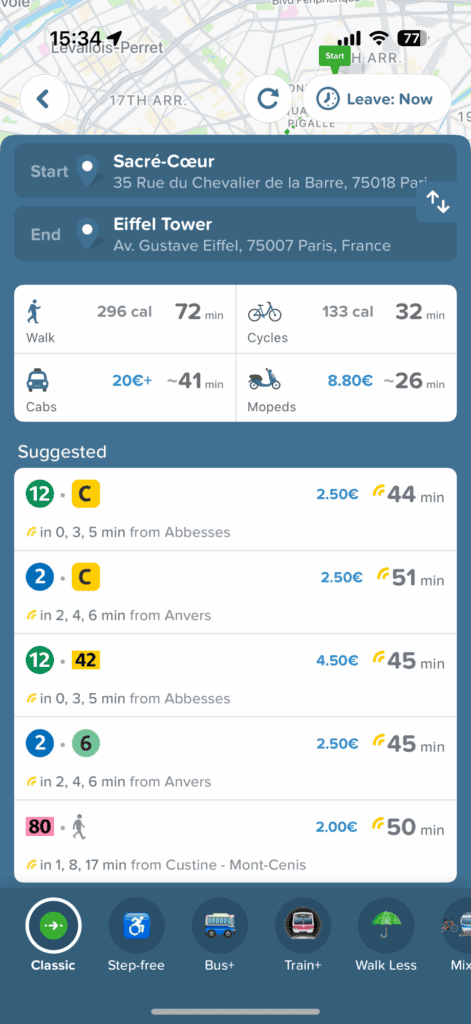
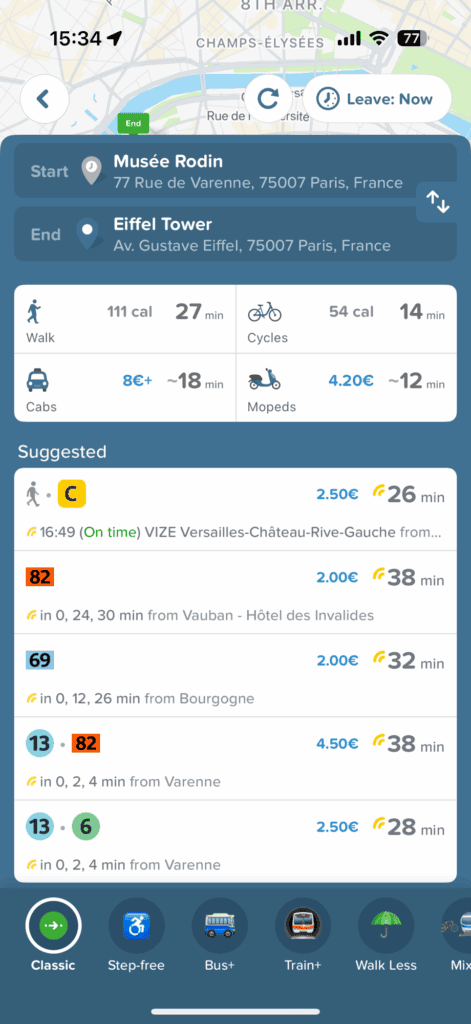
The Citymapper app showing route suggestions in Paris
Once you select a particular route, it gives step-by-step instructions, including where to change trains, where to exit, and walking directions to your destination, as well as live updates when you have an internet connection. There is often no internet connection underground, but the app still tells you the next step.
Citymapper is also remarkably quick to update when there are delays, for example, if a train line is down or a station is closed, and to give alternative options.
Hot Tip: If, for some reason, you don’t have a SIM card and are relying solely on wifi (I don’t recommend this, but I have done it), check the Citymapper route in advance while you are still within wifi range at your hotel/restaurant/museum, and take screenshots of the various steps. This obviously doesn’t work as well as getting live updates, but it is a good alternative.
Google Maps can give public transport route suggestions as well (plus, you can download an area for offline use – I always recommend doing this just in case you need it), but Citymapper is a much better option. Honestly, everyone I’ve converted tells me they can’t believe how much better Citymapper is – you’re welcome.
The Métro

Best for: Quick travel across Paris
The Paris Métropolitan (or the Métro) is Paris’s underground rail system, and definitely the most reliable form of transport for zipping around Paris. There are 16 train lines, and 245 Metro stations – apparently every building in Paris is within 500m of a metro station!
Metro lines are named by their numbers, and each line has a different colour. Trains run from roughly 05:30 AM until 01:15 AM on weekdays, and until 2:15 AM on Friday and Saturday nights, and before public holidays. During peak daytime hours, you can expect a train every 2-4 minutes, but they can be less frequent at night or on weekends.
Keep in mind that not all the lines are air-conditioned, which means it can get very hot underground, even in winter – make sure that you have removable layers. Also, with the constant temperature changes and the crowds, people often get sick after a few days of traveling on underground transport – bring hand sanitiser, and apply it liberally when you exit the Metro.
Important: If you have bought a paper ticket, do not make the fatal error of throwing it away before you exit the Metro station, even after you have passed through the exit barrier. On one of our first trips to Paris, my husband did so – you’d think that, having exited the barrier, you’d be free to get rid of your ticket.
Not so! Waiting around the corner, after the exit barrier but before the metro exit, were some ticket checkers. As it turns out, the rule in Paris (apparently clearly displayed in French) is that you have to keep your ticket with you until you exit the Metro station. The upshot was a €50 fine.
This seemed incredibly unfair, given that they were clearly targeting tourists – they were at the Trocadero station, the most popular spot to see the Eiffel Tower lit up, late at night, just before it was due to begin sparkling.
They would entertain no arguments about how the valid ticket had just been thrown away, and the only alternative was to go to a police station to pay the fine (where we were told it would be bigger). Don’t make this mistake!
RER Trains
Best for: Getting to the suburbs or the airport
The RER has five train lines (named with the letters A-E), which connect Paris to its surrounding suburbs, and are useful for getting to the airport and Versailles. RER trains are slightly less frequent than Metro trains, with one running every 6-15 minutes, depending on the time of day.
If you’re traveling within Paris’s fare zones, you can use your digital Paris Metro-Train-RER ticket on the RER as usual (but not for the airport, for which you need to buy a separate ticket).
Buses and Trams
Best for: Scenic routes, travel above ground
Avoid if you’re in a rush
I have never needed to get on a bus or tram in Paris, as everything I do is either walkable or easily Metroable. Trams, in particular, are mostly based on the outskirts of Paris, and tourists don’t usually use them.
Although you’re unlikely to need them, they do feature on Citymapper, and the tickets are slightly cheaper than train tickets. Also, I often think that bus travel, being above ground, helps you to get to know a city slightly better than an underground train.
Batobus (Seine River Taxis)

Best for: A scenic way to get along the Seine
Avoid when you’re in a rush
If you’re visiting sights along the Seine (like the Eiffel Tower, the Louvre, or Notre Dame), the Batobus is a lovely option when the weather is good. It has 9 stops, and does a 2-hour round trip from the Eiffel Tower to the Jardin des Plantes.
The Batobus is a lot more expensive than trains or buses, but the ticket is valid for 24 hours, and it works on a hop-on, hop-off basis. Since you can use it for the whole day, I see it more as an alternative to a Seine cruise (which usually only lasts a few hours), in which case it is great value for money.
You can get a Batobus ticket here.
Taxis
Best for: Rainy days, late nights, or airport transfers
I’ve had many bad experiences with scammers at Paris train stations, who love to tell tourists that the trains are not running, and that their only option is a (far more pricey) taxi. That’s left a very bad taste in my mouth, so I haven’t used them historically.
However, there are ride-hailing apps in Paris now, which I do use. You can use Uber, Bolt, or Free Now to call a taxi as you usually would, and get a price estimate in advance.
A common misconception is that taxis are always the fastest option. This is worth checking on Citymapper – depending on the time of day, a train might be much faster, and trains are always much cheaper.
Cycling
Best for: Confident cyclists
I must confess that I am not a confident cyclist, and I therefore do not cycle anywhere, but my husband and my friends love cycling (or scootering) around in Europe.
Lime, Dott, and Velib bikes are available to hire in Paris, and their travel times appear on Citymapper.
Walking

Best for: Short distances, getting to know the city
My favourite way to get around is walking, and one of the best things about Paris is that you stumble upon really cool, unique places when you do – I found the Colonnes de Buren and the Pont D’Iena on random strolls. And honestly, Blair Waldorf walked around Paris, so you’re in very good company.
A word of warning: it is very easy to rack up your steps in Paris, as in any European city, so make sure your shoes are suitable for upwards of 12,000 steps per day.
Car Hire/Self-Drive

I’ve never driven a car in Paris, and I wouldn’t recommend it to tourists.
Like most European cities, Paris has emissions rules, expensive parking, and some painful traffic. Also, I doubt that driving in Paris would be a pleasant holiday experience – the roads can be incredibly narrow and confusing, and tourists annoyingly walk into the road for photos (hi, it’s me!).
Some of the driving in Paris, particularly around the Arc de Triomphe, is pretty chaotic. My sister once did a package tour of Europe, and said that when the tour bus (packed with rambunctious students) approached the circle, the music was turned way up and the driver simply gunned it around the circle, where nobody pays attention to lanes or traffic rules. It’s a no from me!
However, if you must do it (all Parisians do weekends in the country), you can hire cars from any of the usual suspects.
How to Buy Public Transport Tickets in Paris
Unlike in London and New York, you can’t tap a contactless bank card on the transport system in Paris. Here’s what to do instead.
There are two kinds of digital tickets, as well as the old paper tickets (which are being phased out this year):
- Ticket Metro-Train-RER (Digital Metro and RER tickets): A single Metro-RER-Train ticket costs €2.50, and is valid for all Paris Metro lines and Paris RER lines in all of Paris’s fare zones
- Digital Tram-Bus Tickets: A single tram-bus ticket is slightly cheaper than a train ticket, at €2, and is valid on buses and trams in all of Paris’s fare zones (except tram lines T11, T12, T14)
The exception for both kinds of tickets is that you cannot use them when you are traveling to or from the airport, in which case you will need to buy a separate ticket.
Here’s how to buy them:
Option 1: Buy a Navigo Easy Pass at a train station for €2, which is a blue plastic card onto which you can pre-load digital tickets. You can buy digital tickets at train stations (there is also an app, but there are sometimes issues using foreign bank accounts).
Option 2: Buy digital tickets on the Apple Wallet app, using a bank card. This is an easier option if you’re confident in your phone’s battery life (I am not, and the Navigo card is my preferred option).
When you enter the ticket barrier, tap the card or the digital ticket on the card reader on top of the ticket barrier, and it will unlock. You don’t usually have to tap out of Paris Métro stations.
Note that the two kinds of tickets cannot be used interchangeably – ie, a train ticket cannot be used on a bus.
Paris Metro Ticket t+ (Paper Tickets)
Until 2025, paper tickets were commonly used in Paris. However, they’re now being phased out and will no longer exist after 31 December 2025 (a pity, since they are great souvenirs and bookmarks).
Even though they are accepted on trams and buses as well as on the Metro, they are only accepted on RER lines inside Paris Zone 1. This makes things slightly confusing when you’re changing trains, and, for example, you’ll need to buy a separate ticket for Versailles.
You can still buy paper tickets at train stations, which you insert into a yellow ticket slot as you enter the ticket barrier. The ticket barrier will validate the ticket, and it will pop back up, and you can enter.
Make sure you take the ticket with you before you go through the turnstile, and keep it with you until you exit the station itself (throwing it away before you exit can be a costly mistake!).
I don’t recommend these anymore because:
- The digital tickets are a lot simpler and can be used across all Paris RER zones (ie, you don’t need a separate ticket to get to Versailles).
- A single paper ticket now costs €2.50, and although it can be used for buses and trams, a single digital tram-bus ticket costs slightly less, at €2. You’re also unlikely to need to use buses or trams while in Paris – I’ve only ever used the Metro and the RER.
- If you happen to throw the paper ticket away after you exit the turnstile but before you exit the Metro station, you could receive a large fine. The paper tickets are also easier to lose.
FAQs About How to Get Around Paris
Can you get around Paris without speaking French?
Yes, you definitely can. Most stations have signage in English as well as French, and announcements are often in English too. Downloading a free navigation app, like Citymapper, makes it much easier. The exits are marked with the French “Sortie”.
Is the Paris Métro easy to use for tourists?
Mostly, yes. The Paris Métro is fast, affordable, and goes almost everywhere. But it can feel overwhelming at first, there are often a lot of stairs, and the lines have numbers, rather than names.
Should I rent a car in Paris?
No, you should avoid renting a car in Paris, as the public transport system is well-developed. Parking can be expensive, roads can be narrow, and traffic can be a pain in Paris.
One Last Tip (Just in Case You Get Lost in Paris)

Honestly, I think it would be quite difficult to get properly lost in Paris, particularly if you’ve downloaded Google Maps offline and marked your hotel.
But just in case, I always make sure I know the name of the closest Metro station to where I’m staying in Paris, and usually it’s easy to remember how to find my hotel from there.
If I did get lost, I would go into a shop or cafe and ask any friendly looking staff member how to get to my Metro station (or at least to the closest Metro station – you can ask the Metro staff for more specific directions to your station).