
The 10 Best Things to do in Iceland in Winter

Planning a trip to Iceland? It’s a bucket list destination for a lot of people, but it can be quite overwhelming – it is such a unique country, and it was like nowhere else I’ve ever been. Honestly, you often feel like you’re on another planet.
We went to Iceland last year to celebrate our wedding anniversary, and it was the trip of a lifetime. I’d wanted to go for about a decade, and I’m so glad we finally made it happen. We drove Iceland’s famous Ring Road over eight days, and it was a very memorable holiday.
They don’t call Iceland the land of fire and ice for nothing, and it is full of contrasts – there are volcanoes and glaciers, snowstorms and hot springs, snow on black sand beaches, terrifyingly dangerous landscapes, but genuinely warm, friendly people.
Read on for the ten best things to do in Iceland, based on our Ring Road trip.
1. Drive the Ring Road

The Ring Road is a 1300km (800mi) highway that circles all around Iceland. Driving the Ring Road takes about a week, and you’re in the car a lot, but you get to see everything that Iceland has to offer. We went to Iceland specifically to drive the Ring Road, and it did not disappoint.
If you’re going to do this, you do need to be comfortable driving in a foreign country, and unless you’re doing the Ring Road (officially known as Route 1) in summer, you must rent a car with Four Wheel Drive and snow tyres, which makes this an expensive aspect of the trip.
Safety Tips for Driving Iceland’s Ring Road in Winter
- Don’t skimp on the car you hire – make sure it has winter snow tyres and Four Wheel Drive.
- Get to your hotel each night in good time before it gets dark.
- If a road is closed, don’t attempt to drive it – if you need to be rescued, you may be charged for the costs.
We had almost zero experience driving in the snow before we took this trip, and a lot of it involved snowy roads. There were parts of the drive, particularly the mountain passes, where there was so much snow that it became difficult to see, and it got pretty scary, so keep that in mind.
We always make our car bookings through Booking.com, which has all the usual suspects and allows you to compare prices.
Check availability and prices for car hire in Iceland here
2. See the Northern Lights

We got to see the Northern Lights on our trip, which was a lifetime bucket list item!
The Northern Lights are visible in Iceland from around September to April, during the Icelandic winter. Iceland is the land of the midnight sun, and the sun is up for almost 24 hours during the summer. This means it’s almost impossible to see the Northern Lights during the Icelandic summer, as the sky doesn’t get dark enough.
We did our trip in February, which was a good time, in theory, to see them. But I had (naively) thought that they’d just be hanging around, all beautifully green and purple and dancing above our heads, which was not the case.
Even at the right time of year, the Northern Lights don’t just show up – you have to go out looking for them. They are harder to see in cities, because of all the light, so your best bet is to go Northern Lights chasing in the countryside, and even then, try to get away from your hotel.
When you eventually do see the Northern Lights, most of the time they look nothing like the pictures that you’ve seen. You get a much better view from your camera, which shows the green colours. To the naked eye, they mostly just look like clouds, unless they’re very strong.
On the night we did see them, we sat in the car on the side of the road for ages, looking at what seemed like clouds in the sky. I was falling asleep, cold and grumpy, and ready to leave when my husband (always the optimist), said he thought he could see them, and took a photo – lo and behold, what we thought were clouds was the Aurora!
I was absolutely ecstatic – life goals! We got decent photos with our phones, but if I’d known this in advance, I might have made an effort to get a better camera for the trip.
If you don’t have a car, you can also book a Northern Lights Tour in Iceland – this one leaves from Reykjavik, and you can book another slot, for free, if you don’t happen to see them the first time.
Check availability and prices for the Northern Lights Tour here
3. Go Dog-Sledding

We did a dog-sledding trip with Snow Dogs Iceland, near to Mývatn. We didn’t plan this terribly far in advance, and only booked it on a whim a few days before – I’m so glad we did, because it ended up being one of the best things we did in Iceland.
One thing to note is that this was probably the most expensive thing we did in Iceland, and we chose it over a hike in a glacial ice cave (which was a similar price). I’m glad we did it, but I do still want to go back to Iceland and do the ice cave, so if you’re glacier-obsessed, keep that in mind.
The dogs are Siberian Huskies, and they were sweet and friendly. They are working dogs, but a lot of them were just as cuddly and licky as our dog. They absolutely love the cold, the snow, and the exercise they get pulling the sled.
What fascinated me about them was how half-wild they became when the females were brought out. The female dogs in heat lead the pack, which apparently keeps the male dogs motivated. The males were harnessed up to the sled first, and then the females were brought out.
We were warned that the males would react when the females were brought out, and they certainly put on a show. This was insanely primal howling, which was a bit like catcalling – like a lot of things in Iceland, I’d never experienced anything like this before.
The actual sledding was amazing – the dogs ran for between 6km and 8km, with a play break in the middle, and I was quite surprised by how fast the sled went. We also stopped for photos, and we got an opportunity to mush (drive) the sled ourselves.
We were a bit nervous about getting cold and not having the right gear, but when we called to check, we were told that we’d be given special snow suits. These were like overalls and kept us very warm.
Check availability and prices for Snow Dogs Iceland here
4. See Epic Waterfalls

Iceland has an almost ridiculous number of absolutely stunning waterfalls. They are free to visit, but some charge parking fees. Here are my favourites, all of which are along the Ring Road.
Tips for Visiting Icelandic Waterfalls
- Wear waterproof hiking boots (honestly, don’t even go to Iceland without these).
- Wear a waterproof parka – especially at Skogafoss, you will get wet.
- Wear crampons over your hiking boots. We made the mistake of not buying these, and my husband had a horrible fall. They sell them at petrol stations all over Iceland.
Gullfoss
Gullfoss, a glacial waterfall, is situated on Iceland’s Golden Circle, and is the first waterfall you’re likely to encounter if you’re driving the Ring Road. It is only about two hours from Reykjavik, so you can see it even if you’re not doing the entire drive.
Gullfoss means “Golden Falls”, because on sunny days, the glacial sediment turns the water a golden colour (I prefer the legend involving a Viking who threw his gold into the waterfall to keep it from his enemies). Also, if it is very sunny, there are beautiful rainbows over Gullfoss.
Even if you’re there in the winter, like we were, Gullfoss is absolutely spectacular. It is enormous, and the sheer volume of water thundering below you, combined with the dramatic black rocks covered in snow, makes Gullfoss stunning and very memorable.
If you’re not self-driving, you can see Gullfoss on this day tour of the Golden Circle. You also see the Kerid Crater, Geysir and the Thingvellir National Park – if you’re not keen on driving, this tour is excellent value for money.
Check availability and prices for the Golden Circle Tour here
Skógafoss
If you’re driving the Ring Road, Skógafoss is the second waterfall you’re likely to see. There is a short walk from the parking lot, but the viewing point is at the bottom of the falls, which is quite unique – most of the waterfalls in Iceland have viewing points from the top.
This makes for very cool views and great photographs, particularly in the snow (although I think the photos of Skógafoss in the summer are amazing too – bright green colours and all the rainbows).
But, it also means that you will definitely get wet – even if you don’t get very close, it is very misty. If you don’t have waterproof trousers, you at least need a waterproof parka, and you might want a change of clothing easily to hand in the car.
If you’re staying in Reykjavik and you don’t want to self-drive, you can see Skógafoss on this day tour of Southern Iceland, which also includes Reynisfjara Beach (the black sand beach) and Seljalandsfoss, where you can walk behind the waterfall.
Check availability and prices for the South of Iceland Tour here
Goðafoss
Goðafoss means “Waterfall of the Gods”, and is in the North, close to Akureyri, Iceland’s second biggest town after Reykjavik. We found Goðafoss a lot less busy and touristy, because it is not on the Golden Circle. That said, being in the North, it was a lot colder than some of the Golden Circle waterfalls.
If you’re in Akureyri without a car, you can see Goðafoss on this tour.
Check availability and prices for the Goðafoss Tour here
5. Visit Black Sand Beaches

Iceland is famous for its unique black sand beaches, which are caused by volcanic activity. Lava hits the ocean and cools, forming basalt rock, which is broken down over time into black sand. Iceland’s black sand beaches, particularly next to snowy mountains, are spectacular.
These are all free to visit, but you will usually have to pay for parking.
Reynisfjara
The first black sand beach which most people see on the Ring Road is Reynisfjara, near Vik, which is Iceland’s most famous black sand beach, which has striking basalt columns. There was still some snow, and the dramatic contrasts were amazing and so beautiful (cue Taylor’s snow on the beach!).
One important thing to note is that Reynisfjara (like a lot of Iceland) can be quite dangerous. You’re not allowed to swim, and there are signs up everywhere warning people about the freezing water and the rip currents. The beach is also known for its “sneaker waves” – dangerously big, unpredictable waves, which seemingly come out of nowhere and sweep people from the beach into the ocean.
Tourists have drowned in the past, and there are signs up warning you not to get too close to the ocean. Don’t mess around with this. I had a particularly eerie feeling, given how few other people were on the beach when we were there.
If you’re in Reykjavik without a car, you can see Reynisfjara on this full-day tour of the South of Iceland.
Check availability and prices for the South of Iceland Tour here
Víkurfjara
The Víkurfjara Black Sand Beach is about 20 minutes’ drive from Reynisfjara, in the town of Vik. You can’t walk there from Reynisfjara, but it is worth going – it’s a beautiful, long beach, with soft black sand.
You can also get great views of the famous Reynisdrangar sea stacks, giant basalt formations in the ocean. According to Icelandic folklore, these are two trolls who were trying to drag a ship ashore, but were caught when the sun rose, and turned to stone.
Sólheimasandur
Also along the Ring Road, and in fact just before Reynisfjara, if you’re heading towards Vik, Sólheimasandur is a black sand beach which is famous for its plane wreck – a US Navy aircraft which crashed in the 1970s.
We didn’t do this because the wreck involves a 45-minute walk from the parking lot, which I wasn’t up for in the cold. But if you’re into photography (or aeroplanes), you can get really cool, unique photos at Sólheimasandur. There is a shuttle to the wreck from the parking lot, but it is notoriously pricey.
Diamond Beach
Another amazing black sand beach is the Diamond Beach, just past the Jökulsárlón glacier lagoon. The Diamond Beach is famous for the icebergs that wash ashore from the lagoon, and look like giant blue diamonds.
We didn’t have time for the Diamond Beach, as it was already getting dark by the time we left Jökulsárlón, and I wish we had planned better – give yourself an extra 30-45 minutes after Jökulsárlón, and don’t miss this.
If you don’t have a car, you can see the Diamond Beach, as well as the glacier lagoon, on this tour.
Check availability and prices for the Jökulsárlón Glacier Lagoon and Diamond Beach Tour here
6. See Glaciers and Ice Caves

Glaciers cover about 11% of Iceland, and there are a lot of things you can do – ice caving, glacier hiking, snowmobile tours, walking around a glacier lagoon, or a boat trip on a glacier lagoon.
Jökulsárlón Glacier Lagoon
The biggest glacier in Iceland is Vatnajökull, and it has a glacier lagoon, Jökulsárlón, nearby. We visited and walked all the way around, which was amazing. The lagoon is free to visit, but there is a parking fee.
If you’re in Reykjavik without a car, you can see the glacier lagoon, as well as the nearby Diamond Beach, on this tour.
Check availability and prices for the Jökulsárlón Glacier Lagoon and Diamond Beach Tour here
I (again, naively) thought we could do a boat trip in Jökulsárlón, around the glacial lake. You can do these in Iceland, but not in February/early March when we were there, because the ice is too thick for the boats.
Ice Cave Tours
If you’re driving the ring road and you want to do an ice cave tour, this is a great place to do it (plus, you may start to run out of glacier after you pass Jökulsárlón). We didn’t get organised in time, and messed around deciding what we wanted to do, and ended up choosing dog sledding instead of the ice cave.
We loved the dog sledding tour which we did, but I definitely felt like I missed out by not seeing an ice cave, and I will definitely do one the next time I visit Iceland – this one looks great.
Check availability and prices for the Ice Cave Tour here
7. Swim in Hot Springs


Vok Baths in Iceland
Also known as “hot pots” (not the food!), there are natural hot springs all over Iceland, and the country is a bit wellness-obsessed.
Vök Baths
The first hot springs we visited were the Vök Baths, near Egilsstaðir, which we stumbled upon. They were newly opened at the time, and ended up being such a fabulous experience.
We saved the Blue Lagoon for the end of our trip, because we had read that it was pretty touristy, and we didn’t want to start our trip like that – I’m glad we did, because the Blue Lagoon was massive, busy and definitely very touristy.
Vök Baths was a lot better – smaller, less expensive, and just felt a lot more worthwhile. The Vök Baths are floating geothermal pools, with an infinity view, and a swim-up bar (the only kind of bar you want on holiday).
Plus, the pools are set on a glacial lake, which means you can jump out of the hot pool, directly into the actual glacier. There was such a great atmosphere whenever anyone went in, with everyone else cheering them on.
You can swim out and touch a piece of the actual glacial ice, which almost everyone loved doing (except me – I just dipped in and came straight back out – I’ve never loved a Wim Hoff cold plunge moment).
Check availability and prices for Vök Baths here
The Blue Lagoon
The Blue Lagoon is the most famous geothermal spa in Iceland. It is surrounded by volcanic rock, and has striking milky blue water. The water is rich in minerals, and is naturally heated, making it beautifully warm all year round.
One thing to note is that the Blue Lagoon is big and touristy, and feels quite impersonal. We knew that in advance, but I wanted to do it anyway, because I am someone who suffers from major FOMO – I couldn’t go to Iceland and not the Blue Lagoon.
From that perspective, I’m glad we did it, but I probably wouldn’t go again. If you’re on the fence, or you’re just a more developed human than me, and you will have no issue knowing you missed the Blue Lagoon, I would skip it and do one of the others instead.
Check availability and prices for the Blue Lagoon here
Earth Lagoon Mývatn (previously called Mývatn Nature Baths)
The Earth Lagoon Mývatn is known as the Blue Lagoon of the North. It has the same blue water as the Blue Lagoon, but it is a lot smaller and less touristy, which is the major drawcard.
We had planned to go to Mývatn, but ended up skipping it as we’d already gone to Vok Baths, but I would come back the next time I’m in Iceland.
One potential downside about Mývatn is that it has a sulphur smell, which is off-putting to some people.
Also, although it is slightly cheaper than the Blue Lagoon, Mývatn has fewer inclusions. With the cheapest Blue Lagoon package, you get a mud mask, a complimentary drink, and use of a towel, which you don’t get at Mývatn.
Check availability and prices for Earth Lagoon Mývatn here
8. See Volcanoes and Lava Fields
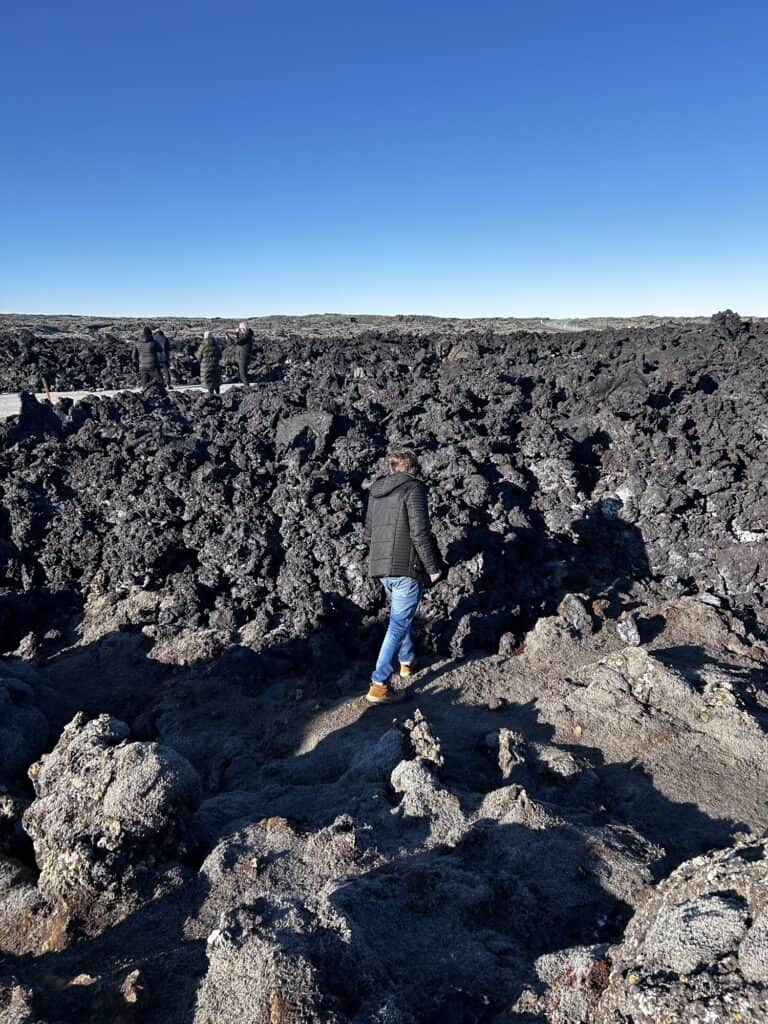

Volcanic lava fields in Iceland
Iceland has over 100 volcanoes, more than 30 of which are active. There are guided hiking tours of Icelandic volcanoes, but that sort of thing is far too extreme for me – the closest we got was this lava field, halfway between the Blue Lagoon and Grindavik.
On the day we visited the Blue Lagoon, we were warned by the staff that the volcano may erupt and that we may have to evacuate at short notice. I assumed this was just them being overly cautious, but the woman assisting us assured me that the risk of eruption was very real.
Well, just after we’d left and while we were driving away from the Blue Lagoon, we received text messages, in Icelandic and in English, urging us to evacuate the area as the volcano was erupting.
Important lesson: do not underestimate the risk of any kind of danger in Iceland – local warnings should be taken seriously.
9. Visit Geysers and Geothermal Fields

Iceland really does feel like another planet – in addition to volcanoes, glaciers, black sand beaches and snowstorms, there are geothermal areas, which felt very moon-like. Like the beaches, these are free to visit, but you will usually have to pay for parking.
The Strokkur Geyser at Haukadalur Geothermal Area
If you’re driving the Ring Road, the Strokkur Geyser at Haukadalur Geothermal Area is likely to be one of the first stops on your trip. The area features mud pools, hot springs and two famous geysers, Strokkur and Great Geysir.
Great Geysir (which is what all geysers today are named after) is no longer active, but Strokkur is a really impressive sight. It erupts every five to ten minutes, much to the delight of the tourists who gather to see it. It’s also close to Gullfoss Waterfall, so you can do both easily.
If you aren’t self-driving, you can see Strokkur, as well as the Kerid Crater, Gullfoss Waterfall and Thingvellir National Park, on this full-day Golden Circle Tour.
Check availability and prices for the full-day Golden Circle Tour here
Hverir Geothermal Field
Hverir is close to Lake Mývatn in northeastern Iceland and is part of the Krafla volcanic system. It is a very striking landscape, which feels like another planet – there are steam vents, mud pots and mineral deposits, and you get the feeling that the area is very alive (warning, it is also quite sulphuric).
If you’re in Akureyri without a car, you can see Hverir, as well as Goðafoss and Lake Mývatn on this tour.
Check availability and prices for the Hverir, Goðafoss and Lake Mývatn Tour here
10. Sample Traditional Icelandic Food


Fermented shark and hot dog condiments in Iceland
I’m ashamed to admit that my tastes have become a lot less adventurous as I’ve gotten older, because teenage me would definitely have tried shark, horse, or puffin, all of which you can eat in Iceland.
In case your tastes are as conservative as mine, try Icelandic lamb soup, the freshest trout you will ever have, skyr (Icelandic yoghurt), lava salt (bring some home!), local Icelandic gin, rye bread ice cream, and Iceland’s famous hot dogs.
If you’re in Reykjavik, the best way to try Iceland’s delicacies is on a walking food tour (we didn’t have time for this, but I’m dying to do it next time). This Reykjavik food tour gets a perfect score from over 18,000 reviews.
Check availability and prices for the Reykjavik Food Tour here
Planning your Iceland Adventure
Iceland is like nowhere else on earth, and it is a once-in-a-lifetime adventure – seeing the Northern Lights and dog sledding with Siberian Huskies were bucket list items for me. The black sand beaches, local legends and otherworldly landscapes made it a very memorable trip.
I hope this post has inspired your wanderlust. Check back soon more of my Iceland travel tips and my Ring Road itinerary.